Voting in the Illinois Midterms 2026

Well it’s that time again. The time when we all say, “the system doesn’t work!” And then promptly go back to using the exact system as if it worked. So here’s who I’m voting for in the next election: https://bluevoterguide.org/edit-ballot?pbid=20c6e9ec430305face96acad0cca79a560

I consider myself a staunch undecided voter. I feel passionately that I don’t know who to vote for. I googled (actually Duck Duck Go’d) for recommendations. The only one I could find was the Blue Voter Guide. https://bluevoterguide.org/. I would use a red voter guide, but there isn’t one. And for midterms, you have to pick either red team or blue team. I’ll go with blue team for now and if the red team picks a candidate that isn’t stark raving mad, I may choose them instead.

Representative, U.S. House Illinois District 13


Nikki Budzinski

I like that Rep. Budzinski is bi-partisan and cares about the climate. The other guy looks fine, but I think the incumbent is doing a good job.

Illinois Comptroller


Holly Kim

I think Kim has real experience and she seems passionate about the job. I also like that she wants to modernize the system. You know, one reason government is bad because it’s inefficient, but it doesn’t have to be. There’s no reason why government couldn’t be both bad and efficient, and I think Kim can help us make it that.

U.S. Senate Illinois

Raja Krishnamoorthi
https://rajaforil.com

I like Raja. That’s what his website says to call him. I like that he has plans. Real, thought out, well written plans: https://rajaforil.com/plan/trump-accountability-plan/

Champaign County Executive

Sanford Hess
https://dragonfly-heptagon-7shb.squarespace.com/about-sanford

I choose Sanford Hess. He seems to have put more thought into his role and what he would do.

Wow I just did 2 hours of research on a bunch of people, and most of them won’t even win!

My Stock Portfolio Performance 2025Q2

I’m still at -15.77% YTD. That’s about where I was in Q1. I took a break from trading. I have one or two options that I’m waiting to expire. I’m sitting on a big pile of cash waiting for the next economic collapse. It happens every 5-7 years. The last one in 2020 almost doesn’t count because we printed so much money to get out of it. That just inflates the bubble and kicks the can down the road. Here we are down the road. it’s just a matter of time. Talk to you at the end of Q3.

Totally reasonable proposals that will fix everything and not have any negative consequences

I’ve compiled a list of my best ideas that will fix everything and not have any negative consequences. If you like these ideas, then they are serious recommendations. Let your local law maker that you want to see these changes. If you don’t like these ideas, they are purely for entertainment purposes and meant only to stimulate inquiry. Try to smile and enjoy.

Random agency closure

Every year, one agency gets closed, chosen at random. Maybe 2026 is the year the CIA closes up shop. Maybe 2027 is the year that the FDA shuts the doors. Instead of each president playing with the funding, increasing or decreasing as they see fit, the agency just evaporates overnight. If we need the agency, we can recreate it the next year. If we find that nothing has changed, then we are apparently better off without that agency. We won’t know until we try. It’s like the fable of the little boy on the corner selling “tiger whistles.” There’s no tigers, so what’s the point of the whistle? “No, no,” says the boy, “there’s no tigers because of the whistle.” We can’t know if he’s telling the truth unless we try getting rid of the whistles. It could be snake oil, or rabbit’s feet. We can’t know if they are beneficial unless we have something to compare it to.

Random voting

There has never been an election decided by a single vote. It’s a myth that a single vote counts. If it really ever came to a single vote, they would just recount. It’s essentially an axiom that a single vote doesn’t count. Therefore, there is no rational reason for an individual to vote. Maybe there is an emotion. Voting makes you feel powerful, proud, and morally righteous. Maybe there is a sense of duty. But ultimately it’s not a rational decision. There is a way to fix this! Assign each ballot a number. Number as many ping pong balls as there are votes and put the balls in a cage. Shake the cage a bunch. Then pull out a single ping pong ball. That’s the winner of the election!

Ars-tocracy

Our legislative bodies are ailing. Their time is entirely consumed with debate and filibuster. They give long speeches to each other. The speeches fall on deaf ears. It’s purely performative for their constituents to show how hard they are fighting. Talk is cheap. And speeches aren’t the only performance and are hardly the best way to convey a deeply felt message. From now on, Senators and Representatives will be required to make their points using anything but speeches. Suggestions include: interpretive dance, live theater, stand up comedy, short film, painting, and sculpture. They will save their breath and we will see what they really feel in their heart.

Tax reform

No taxes: No sales tax, No income tax, No property tax. Nothing. But everyone has an obligatory 10 year commitment to work for the government. You can be a high school teacher, construction worker, or bureaucrat. You can’t work in the private sector until you’ve earned your work-license.

My Stock Portfolio Performance 2025Q1

I biffed it in the stock market this quarter.

2025 YTD

I was trying this strategy where I bet on the stock market collapsing. I bought several large puts on the S&P500, and some FAANG stocks, and then the stock market plunged. (That’s a good thing when you have put options: it gives me the ability to sell the stock at a higher price that it is currently worth).

I was so proud of myself. I had large “paper” gains. A paper gain is when the item is in high demand and can be sold for a large profit. Unfortunately I didn’t sell. I got greedy. I double down and bought even more puts. And just like all of the suckers before me, since the dawn of the stock market in Holland, before the tulip craze, the market did a 180 and recovered. My paper gains were erased and replaced with giant losses. The puts I bought were set to expire worthless. I sold them at a loss to recover some of the money invested instead of loosing all of the money. Frick! I’m confident I can make it back, but that was a very painful lesson to learn.

2025Q1 – Rolling 3 months

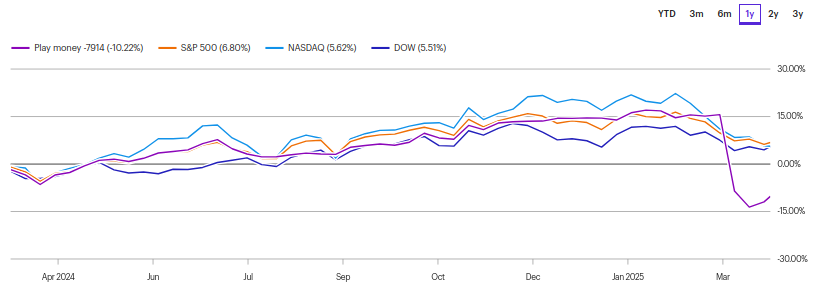
That peak in my portfolio around March 10th is when the stock market plunged, and the subsequent plummet is when I bought a bunch of worthless puts. Stock options are incredible multipliers.

Rolling 6 months

This is all my “fun money.” I am not investing my retirement money. This is excess money that I have squirreled away that I gave myself permission to do what ever I want. I’ll keep playing these slots for a while and if I really can’t beat the market, then I’ll find some other slots to play. I’m not afraid to walk away.

Rolling 1 year
Rolling 2 year
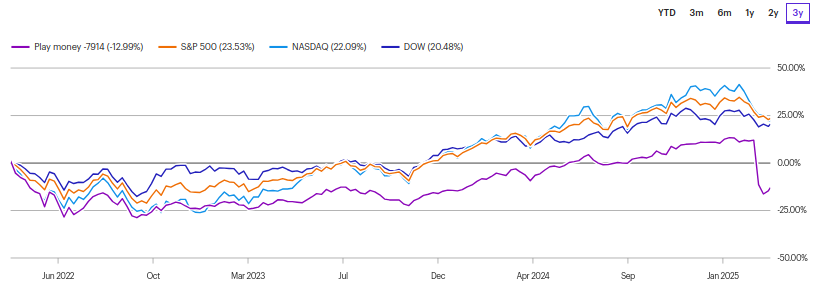
Rolling 3 year

Damn. I just made it out of the negatives.

Why I quit Facebook (again)

Information information everywhere and not a thought to think.

I quit facebook again, and this time it feels like for real, at least for now. Three things really tipped me over the edge.

The Time Value of Time

The first was how time consuming it was. I could sink hours into it at a time, and not remember a single thing that I saw. It was a blur. It was like getting blackout drunk. Getting tipsy is fun, but getting wasted is not. Time is the most precious resource on earth because you can never get it back. Once it’s spent, it’s spent forever. I wasn’t getting any value for the time spent on facebook. I was just spending it. And just like an alcoholic, I kept going back, not matter how badly it screwed with my life. The first step is admitting you have a problem, and I can easily admit you have a problem.

Dirty Slots

The second is that it was addicting like a slot machine. I would post something funny, and then check back after 1 minute, 5 minutes, 10 minutes, an hour, a day, a week, a month. I kept coming back to check how many laugh emojis I got. I wanted to know who was engaging with my “art work.” I considered myself a “facebook status comedian.” In hindsight, it’s embarrassing. I was creating art for corporate overlords that paid me in laugh emojis. “Here’s an idea, try being a real comedian and doing it for the laugh emotions of people.” I say to myself. I don’t need corporate overlords to create a platform. I’m not their puppet doing their tricks. I’m my own puppet and I’ll do my own tricks!

Whose Update is it Anyway?

Welcome to facebook, where the points are made up and the jokes are too. I realized that the points are made up and no one cares, and the people who do care, don’t matter. I watched an episode of the TV show “Black Mirror” that parodies our current world of being obsessed with rating each other and how it’s turned us all into popularity monsters. Then I watched an episode of “Community” which parodied Black Mirror. I realized I don’t want to be like those people. It was a good wake up call. It’s also liberating now that I don’t know and don’t care about what other people think of my facebook updates.

It’s been good without it. I feel like I broke up with an pitiful partner. Queue the music up: Cher’s “I don’t need you anymore,” Gloria Gaynor’s “I will survive” and Elton John’s “I’m Still Standing.”

Book review: “1984” by George Orwell

I read the book 1984 once when I was a vitriolic teen and now I’ve finish it again as a cynical, old, shriveled up adult. I remember being so fired up about the book the first time. I was shook! How could this have happened in real life after a guy warned us about it? How come it was happening right now in America? I don’t feel that way any more. Now that I have a mortgage and a paycheck, it seems fine to me. Long live Big Brother!

1984 is a psychological horror in many ways. The main character, Winston Smith, lives with a constant state of paranoia. There’s always someone out to get him, and constantly watching his every move, and listening to his every whisper. He’s constantly afraid that the government will dispose of him, aka, kidnap, torture, interrogate, then kill, and remove all records as if he never existed. It’s a justified paranoia. He lives with a government that has evolved into a Technocratic, Authoritarian, Totalitarian, Welfare – Warfare State. Each gear in the machine powers the other gears. Technology has progressed to an unprecedented level that has enabled the government to spy on every single citizen 24/7. Technology has gotten so good, that they now need to waste the surplus production, just to keep people busy. They waste surplus production with mismanagement, complete welfare, and endless total warfare. The country (“Oceana” is indefinitely at war with either Eurasia (Russia plus Europe), or Eastasia (China, Japan, and the rest). They need to constantly be at war, in order to boost morale, increase comradery, and waste surplus. They need to waste surplus, to maintain totalitarian control. They need totalitarian control to win the war. The government is simply and end to itself. Everything is in service of maintaining the status quo. It is only interested in perpetuating its own existence and happens to help the citizens by accident or reluctantly. Yeah that’s terrifying.

Yes, in many ways, America is this Technocratic, Authoritarian, Totalitarian, Welfare – Warfare State. Facebook, Amazon, Google, Microsoft, etc. spy on us 24/7 and listen to our every whisper to try to predict our thoughts. We seem to have been at war ever since our founding. The military-industrial complex is as robust as ever. And there seems to be an abundance of desk jobs in America that are fairly meaningless. I’m basing this off of the movie “Office Space,” the comic “Dilbert,” the show “The Office,” and my job when I worked at Chrysler. Media may exaggerate the degree of meaningless jobs, but now we’re just quibbling about the degree. And we also have a cult of personality around our leaders and a demonization of the opposition party leader and dissidents.

But I also found it clownishly unrealistic. You know how some people watch horror movies and find them funny? That’s how I felt about this book. It was just absurd. The premise defies logic and ignores all of human history. Human civilizations are capable of horrific atrocities, but they are never permanent. No civilization has ever lasted more than a millennium, and even if it does, it changes along the way. Soviet Russia is probably as bad as human civilization has ever gotten in terms of a Technocratic, Authoritarian, Totalitarian, Welfare – Warfare State. And it could have been worse, but it still wouldn’t have been permanent. It wasn’t sustainable. Maintaining civilization is like trying to unicycle during an earthquake. It requires balance and changing direction and eventually falling over.

The other part I found absurd was his acceptance of the status quo, and the simultaneous rejection. On the one hand, he knows that he could be caught for something so he lives a quite life to stay out of trouble. On the one hand, he knows that he will be caught for something so he commits all sorts of crimes, since he’ll be caught for something anyway. That dichotomy didn’t resonate with me. To me, a life only has meaning if the choices have consequences. If you eat healthy and exercise and your body gets in shape, that’s a meaningful decision. If you eat healthy and exercise and you still don’t get in shape, then why did you exercise? It’s a meaningless decision to exercise or not, because the result is the same. If Winston knows he will be caught, then why bother acting coy? Why not live life to the fullest and enjoy what you can? I could not relate to the main character. I was disappointed that the main character didn’t do much. Mostly things just happened to him. I didn’t like that the main character had no redeeming qualities, other than a dislike of the government. I was disappointed that his female counterpart was just a brunette with legs. She didn’t have much more personality than a cardboard cut out. Initially Winston wants to bash her brains in with a rock when he first sees her, because she comes off as a prude and a member of the thought police. But when she secretly confesses her love for him, suddenly he falls in love. Does he actually love her? Or does he just want to get laid?

I just so happened to listen to the first third of the of Apology of Socrates where Socrates is giving a speech to 500 of his fellow countrymen. He says, “I don’t care if you kill me. I’m not worried about my body. I’m worried about my soul. I’d rather have a crime committed against me, than me commit a crime against another.” That was reassuring to hear. Compare that to what Winston said when offered a position in a secretly anarchist society. The anarchist recruiter asked if Winston was willing to: kill, steal, throw chemicals in people’s faces, even to innocent people. And Winston gave a resounding yes. He would do anything if it meant bringing down Big Brother. Between Socrates and Winston, who do you think died a good death? Who do you think had more people beside their bed weeping for the loss?

For all of 1984’s faults, it did have some extraordinary writing. It was gorgeous to read. It was like reading poetry. It was very “sensuous” in the sense that there were a lot of sense words. Every apartment smells of boiled cabbage. The cafeteria stew was pink with a metallic taste. A glass paper weight feels hefty and solid and seems to contain all of humanity frozen inside of it. The writing did an excellent job of painting this bleak world in my brain. It felt like I was there.

My Stock Portfolio Performance 2024

I did extremely well in the stock market this year.

2024 YTD

My line is the purple one, 2nd from the top on the right. NASDAQ beat me, but I beat the S&P 500 and DOW. How did I do so well? I don’t really know. Mostly I invested in an ETF called ESGV, which is a total stock market fund, minus stocks that deal with pornography, guns, and tobacco. So I did as well as the stock market. Nothing really surprising there. I also dabbled in picking stocks. I did miserably. You can see the lag starting in April to when I gave up in June. Recently, I have been buying call options on stocks that I think are going to go up. Call options are nice because there’s a fixed amount of money that I can lose, but an infinite amount of money that I can gain. That’s the idea anyway.

Rolling 3 months

On a rolling 3 month average, it’s pretty much a wash. Nothing exciting above and beyond the rest of the pack. That peak in October is when I was holding onto an ETF that traded in gold mining stocks. There was some sort of bonanza for a few days. Some political upheaval. I was congratulating myself, patting myself on the back for a job well done. I picked the lucky numbers in the lotto and that makes me a genius! I happened to be off work that day. I was watching the stock sky rocket. I could have sold, but I was too busy adjusting my monocle. Then a few days later the bubble popped. As it always does. I sold. I made a profit, but not as much as I could have.

Rolling 6 months

On a rolling 6 month basis, it’s basically another tie.

Rolling 1 year

Again I’m doing as well as the NASDAQ.

Rolling 2 years

This is where it falls apart. I’m now in 3rd place.

Rolling 3 years

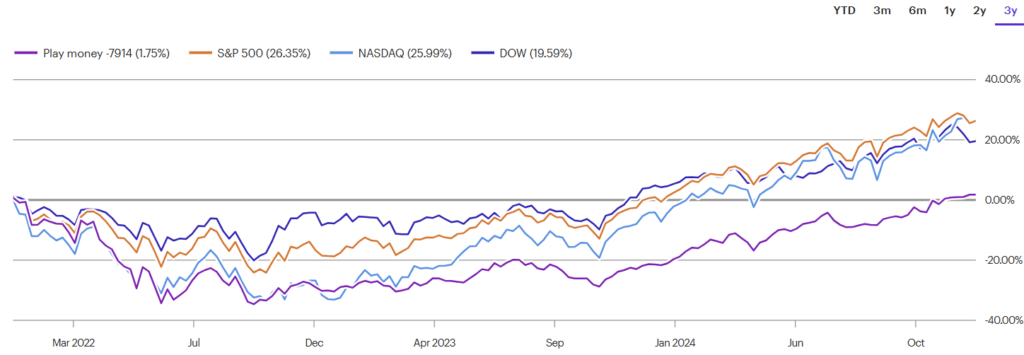
This is really embarrassing. I don’t know what I was doing 3 years ago. For a verrrry long time, I actually lost money in the stock market while everyone else made money. I’m even more distressed because of the opportunity cost. Instead of earning 20%, I earned just barely broke even. If I had just invested in the total stock market, I would be up so much more by now.

This is all well and good, but my investing horizon is 30 years. I don’t care if I have two years of 30% return if it means that in three years I have 0% return. The only metric that matters to me is my 30 year return.

Look for another update next year!

Summary of “How To Drive a Nuclear Reactor”

I just finished a marvelous book called “How To Drive a Nuclear Reactor” by Colin Tucker. It’s about the engineering inside nuclear power plants and some operator duties. It’s a very good explanation in plain English. There were a few typos which was jarring, but forgivable. I suppose that’s what happens when you let an engineer be a writer. I am going to write a summary of the text so I can review it later if I ever need to.

The first topic covered in the book is the nuclear/atomic/particle physics. All of mater is made up of three “fundamental” particles. I put fundamental in quotes because even those particles are made of smaller things which are irrelevant for the subject at hand. These three particles of import are: protons, neutrons, and electrons. Protons and neutrons have roughly an equivalent mass and the electron has a hundred thousandth of the mass. A minuscule, negligible amount of mass for this topic. The proton has a positive charge. The electron has a negative charge.

The elements are classified by the number of protons in a lump. If you have a lump of two protons, then you have helium. If you have eight protons, then you have oxygen. These lumps are called a nucleus. These nuclei pick up electrons that float by. The positively charged protons attracts the negatively charged electron. Protons do not particularly like being lumped together. Since they all have the same charge, they find each other repulsive! They yearn to fly away at the soonest convenience. And they would fly away except for the fact that they are “glued” together with neutrons. Neutrons apply a force that is similar to gravity or electrical charge, except it is wayyyyy stronger but only works at verrrrry close range. Imagine if you took two magnets and glued them together North pole to North pole. Then you tap it just right. Pew! The two magnets would break apart and whiz away in opposite directions. This is a good metaphor or a helium nucleus because it only has two protons. Now imagine gluing 92 magnets together. You can imagine how much more fragile this configuration is. Helium usually has two neutrons to hold together the two protons. Oxygen usually has eight neutrons to hold onto eight protons. Iodine has about 73 neutrons to hold the 53 protons together. And uranium usually has 146 neutrons to hold 92 protons in place. You need more and more “glue” to hold onto these volatile protons.

Here’s the clever bit of physics that let’s us power light bulbs with neutrons. We actually don’t want Uranium that’s stable. When we find uranium ore in the ground, it’s in the most stable state with 146 neutrons. We want Uranium that is fragile. We want it to be balanced like an extra tall tower of Jenga blocks. We purposefully remove three neutrons from the lump. This is effectively like using less glue in our magnet pile. That way, it just needs a ever so gentle tap, and the whole thing splits apart. It’s like having dynamite with a very short fuse. We want it that way because we can put a bunch of uranium in one very dense pellet. Each fission of uranium nuclei will send neutrons firing off like bullets in every direction to hit other uranium nuclei. It’s like a truck full of dynamite. Each dynamite stick sets off another dynamite stick. Or like a Old Western movie where every poker disagreement in a saloon inevitably evolves into an old fashioned bar fight.

Now onto the engineering. You can imagine that a truck full of dynamite releases a lot of energy. But how to harness that energy? It boils down to (pun intended) a steam generator. Water passes by the explosions, it heats up, it creates steam, the steam pushes a fan, the fan is attached to an electric motor, the motor has coils of copper wire and magnets. When the magnets pass the coils of copper wire, electricity flows.

There are two predominant ways of creating steam for the generator. You can either use two water loops, or three. A water loop is a circuit of pipe. There is a pool of water, a pump that pushes the water through the pipe, then it returns to the pool and repeats. The technical term for the pool is “reservoir.” For a three loop system, we’ll call them A, B, and C. The uranium fissions are miniature explosions that release a lot of heat. The water in Loop A swishes and swirls around the uranium pellets. The heat is absorbed by the water. The water flows through a heat exchanger where it gives up it’s heat to Loop B. And then it flows back into the pool to repeat the process.. It adsorbs heat from the uranium, and then gives the heat to Loop B, absorbs heat from uranium, and then gives it to Loop B, etc. Loop B starts in a completely separate pool. The water never mixes with Loop A or C. It gets pumped out of the pool and goes through the heat exchanger and absorbs the heat from Loop A. It gets so hot that it immediately boils and turns to steam. When water evaporates, it expands by 400x. So it creates a tremendous gale force wind. This wind turns a fan blade. The technical term for these fans are turbines. The turbines are fixed to a shaft with an electric motor.

If you apply power to an electric motor, it turns, like a desk fan. If you turn an electric motor, you get electric power, like a wind mill. Inside of an electric motor are coils of copper wire and magnets. When a magnet passes a copper wire, it pushes electrons through the wire.

After the steam passes through the turbine, it gets condensed back into water and returned to the pool for Loop B.

Loop A and B are “closed loops” because it’s a complete circuit. Loop C is an “open loop” because they take sea water or lake water and return it. The lake or the sea is the reservoir. It gets pumped in to another heat exchanger, absorbs the heat from Loop B, and then returned to the sea or lake. That absorbing of heat is what condenses the steam in Loop B.

For a two loop system, there is no Loop A. It’s just Loop B that turns to steam and Loop C that condenses the steam. A three loop system is called a PWR (Pressurized Water Reactor) and a two loop system is called a BWR (Boiling Water Reactor). PWRs are safer because during a failure, usually only Loop A is affected and everything else is isolated. It’s easy enough to clean up. While a BWR is more efficient because heat exchangers are inefficient and it uses one less. But it’s more dangerous because the water that is turning to steam and powering the plant is also cooling the uranium pellets. If there’s not enough water, the pellets explode like a truck of dynamite. And you have radioactive steam on top of that.

Back to the uranium. It’s explosive. We need to be able to control it. We need a “neutron sink.” Just like a kitchen sink drains water no matter how much you have the faucet turned on, we need a way to absorb neutrons no matter how many explosions there are. When the uranium nucleus fissions (breaks apart) and shoots of neutrons like bullets, we need a punching bag dummy to absorb some bullets to tame the barfight, so to speak. There are two main ways of doing this. One is with graphite rods. Graphite is a special arrangement of carbon atoms. The carbon atoms are happy to absorb stray neutrons without breaking apart. The graphite rods are inserted in channels along side the uranium pellets and can be withdrawn an inch at a time as needed. The more they are inserted, the more neutrons they absorb. The second method is with boron dissolved in water Loop A. The boron is also happy to adsorb stray neutrons without breaking apart. The operators in the control room can also control the boron concentration in the water.

Those are all the juicy bits!

The fastest way to need a change of shorts in Vietnam

I’m writing this from Vietnam. I keep waffling between writing one mega post, and writing several mini posts. On the one hand, there’s so much I want to say! On the other hand, I keep waiting for the perfect time to write it all, and it never comes. I’ve decided on a mini post to tell you the fastest way to need a change of shorts in Vietnam.

You know how in America, if you’re in the right lane and you need to get to the left lane but you already missed the turn, you just keep going and make a loop. Well in Vietnam you come to a complete stop and force your way into the left lane. Assuming you’re in a car. If you’re on a motorcycle then you speed up and to squeeze between the cars on the left and right. In America, you come to a red light and stop. In Vietnam, you speed up and pass everyone on the left, or the right, it doesn’t matter, just as long as there is room, and by room I mean I could reach out and high five the person next to me. And there are no left turn arrows in Vietnam, you just cross into oncoming traffic. The traffic never stops, there is no break. You just go for it and people slow down slightly and steer around you. Oh, you know how there are one way streets? Well if you want, you can just go the opposite way. Also, the curbs are angled so you can drive up on the sidewalk.

Yeah it’s absolutely insane. I’ve never seen anything like it. The streets have a constant stream of mopeds and motorcycles. It’s non-stop from 6am to at least 10pm when I got to bed.

In America we have Uber or Lyft as a ride hailing service for cars. In Vietnam we have Grab for both cars and motorbikes! Yes you can hop on the back of a very experienced rider/driver of these fine vehicles and you will absolutely destroy your shorts. It is terrifying! But also exhilarating! If I only had 24 hours in Vietnam, I would book a ride on a motorbike just for the thrill of it. I even rode in the rain! I can’t believe I’ve been here for 9 days, and I’ve seen a million bikes, and I have yet to see even a single accident. I think part of the magic trick is that the fastest we go is 25mph. It’s just like looking at a magic trick. Even when I know the trick, no matter how many times I see it, it’s still magic.

I also rented a motorbike! I hired a motorbike rider to take me to the rental shop. I paid ~$7USD and rode 1 mile to our hotel. It’s fun! But you have to have nerves of steel! Luckily riding home I only had to make right turns. Then I got Yen to come take a ride with me around our hotel. We did a bunch of laps making only right hand turns. I know she’s the one because she was willing to put her life in my hands!

Then the next day when I had to return the bike I performed the death defying stunt of making a single left turn into traffic. The route back had only a single left turn, but I was too chicken so I passed it. This added two more left turns to my route! I tried to make a right hand turn, but that added two more left hand turns! Eventually I just took the plunge. I survived!

I definitely recommend hiring a rider and also renting a scooter for a day. Everyone who has lived has loved it!

Me and Yen after I took her around on the bike
Yen is still practicing her riding skills…
Yen is looking very demure. She takes everything in stride. Cool as a cumber.

Global Weather Change

A good conspiracy theory strings together disparate bits of information into an obvious conclusion. This is an anti-conspiracy theory. This is more of a Jackson Pollock than a Da Vinci. I invite you to appreciate these bits and see if there’s a painting in there.

It took me a long time to believe in “Climate Change.” I couldn’t stand the conclusion that this is my fault, therefore, climate change must not be real. So I want to break it down and look a few facets of this gem. This is also a partly a letter to my 20 year old self to help explain my current thoughts on the matter.

What even is “Climate Change?”

Let’s start with the idea that it’s not your fault. It’s not anyone’s fault. It’s not China’s fault. And it’s not Exxon’s fault. Let’s start with data. One form of data is anecdotal. The benefit of anecdotal is that it’s easy, the bad part is that it’s not reliable. It’s easy to say, “Gee, it seems hotter this year, but maybe I’m remembering incorrectly.” Maybe as we get older we focus more on the weather so it just seems hotter. Ok, let’s not start with anecdotes. Let’s start with recorded data. Presumably, there’s a thermometer at City Hall or something and the intern reads the temperature and records it.

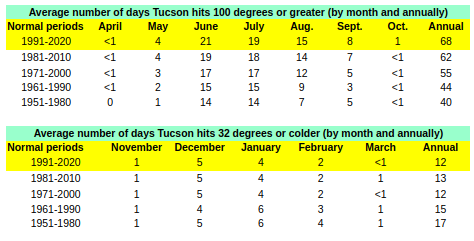
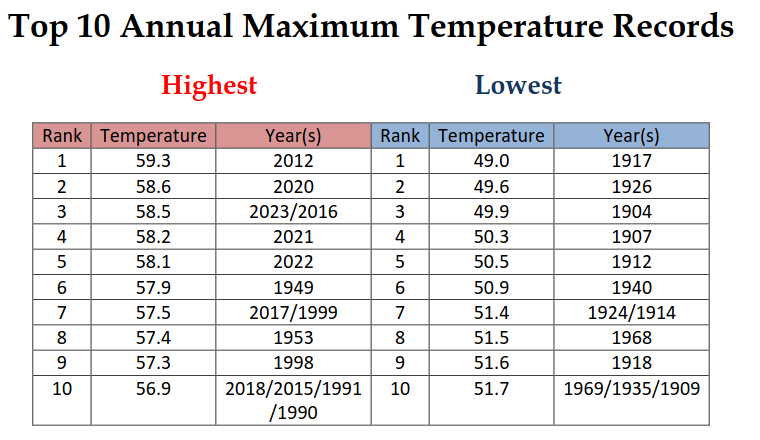
https://www.weather.gov/twc/TucsonMonthlyNormalExtremes

Here’s rolling 30 year period since 1950. A rolling 30 year period (over lapping 30 years) should smooth out the extremes of any particular year. This trend shows it’s getting hotter in Tucson since 1951.

Ok but that’s just Tucson, AZ. What about other places?

It looks like the data goes all the way back as far as 1904, and the top 10 highest temperatures are since 1949 with the vast majority in the last 15 years. When people talk about climate, this is what they are talking about: weather trends.

And yeah, sometimes you get a cold winter. Sometimes you get a mild summer. That doesn’t prove or disprove climate change. It pisses me off when it’s cold one day in late summer and people say, “Well I guess climate change isn’t real!” Gah! We’re not talking about one day, or one season, or even one year! We’re looking at over all trends, not blips.

Ok fine, I guess Climate Change is real. It’s still not my fault. Climate Change happened way before I got here.

I agree! Climate change seems to have been happening since there was oxygen on earth. There are cycles and ice ages, etc. etc. They have this thing called, “Paleoclimatology” which is “data are derived from natural sources such as tree rings, ice cores, corals, stalagmites, and ocean and lake sediments.” 1 You know, trust it at your own will. Seems a bit hokey to me. It requires a lot of interpretation. But, hey, Einstein conceived of the General Theory of Relativity out of thin air and so far that’s worked for us. If we’re going to require one science to meet a certain level of scrutiny, then we should require all science to meet that level of scrutiny. And since I’m not going to independently verify the speed of light, I’m just going to take Einstein’s word for it. Same for Paleoclimatology.

https://www.climate.gov/maps-data/climate-data-primer/past-climate

Do Scientists Even Agree With This Stuff?

I remember a big debate about what percentage of scientists agreed that Climate Change was real. Who cares? What if none of them think it’s real? That doesn’t change if it’s real or not. The Royal Society of London’s motto is “Nullius in verba” which means “Take nobody’s word for it.” That’s according to Wikipedia. I haven’t independently verified that is their motto or what it means. At some point it’s impractical to be that skeptical. On the other hand, did you know they removed the word, “gullible,” from the dictionary? We have to use our judgement of how skeptical to be.

So the temperature suddenly goes straight up in the late 1800s, right around when we had the industrial revolution. It could be a coincidence.

Yes, it could be. But it probably isn’t. The earth is full of feedback loops. One of the feedback loops is that the hotter the surface is, then the air can hold more water vapor, which traps more heat, which causes the surface to be hotter. A negative feedback loop is when water vapor condenses on dust particles and forms clouds which block light, which lowers the temperature, which reduces the amount of water vapor that the air can hold. Carbon dioxide also has a heat trapping effect, but no cloud forming effect. This tips the balance in favor of holding more water vapor. This is one form of climate change, but there are as many forms as there are feedback loops.

Ok CO2 causes climate change, how do we know that we caused it? Maybe it was the volcanoes or the cows?

Maybe, but probably not.

All of your data are cherry picked and you’re all a bunch of liberals trying to bully me

I know it can feel that way because I used to feel that way too. I don’t like the idea of it being my fault, or having to change, or that I might be wrong. It feels bad, like hurtful. But what I found is that if I do independent verification and searching for the truth on my own terms, it feels good to come to a conclusion for the right reasons.

  1. https://www.ncei.noaa.gov/products/paleoclimatology ↩︎

You like apps? How ya like this app?

I finished making an app. It was a joyfully painful experience. The best part was the programming. The worst part was the publishing.

I chose to use a language called Dart and a “framework” called Flutter. I don’t know what a framework is. All I know is that Flutter’s selling point is that I can publish on any platform. Luckily Dart is a mix of HTML and Java. And Java is an offshoot of C++, and C++ is an offshoot of C, which is an offshoot of Assembly, which is an offshoot binary. Luckily I’ve taken a class in all five of those (Java, C++, C, Assembly, and binary). I have to admit. ASU, for all it’s faults, does actually teach some high quality computer science classes.

My goal for the month was to write and release an app to the public by June 30th. I finished programming in the first 15 days, and then wept over the keyboard trying to publish for the next 15 days. Ultimately, I was able to publish for web, but I did not publish to any app store. I’m maybe halfway through on the Google Play Store. I paid $25 for them to verify my identity, filled out all of the questionnaires about the privacy and data collection my app doesn’t do, made a logo, made a store page, and now I’m stumped. I was following along on a YouTube tutorial, I renamed my app, and that seems to have ruined everything.

My plan for July is much more humble, I just want to finish publishing to the Google Play store. That is going to be enough of a challenge for me.

Anyway, check out my first ever publicly released app here if you want: https://tucsonr.github.io/Mutli-arm-bandit-web/

Fully disclosure, I used AI to do a significant amount of programming for me.

Lord Richelson

I just finished “Every Landlord’s Tax Deduction Guide” by Stephen Fishman of the Nolo publishing company. This was the Idiot’s Guide to Cover Your Assets. Let me share the best lessons.

Chapter 1

Income

The government is gracious enough to only take money out of your pocket. By that I mean, if you charge someone $5 for a sandwich, and it costs $5 in ingredients and labor to make the sandwich, no money is going in your pocket. The government is happy to let you fill your days with these “wash sales.” The first half of the equation is your money coming in, your income. That is rent and the sale of houses. It also includes a security deposit if you keep it as the last month’s rent, late fees, parking fees, and laundry fees. More on the second half of the equation later.

Ownership

Sole Proprietorship

A sole proprietorship is a one man, one house relationship. Just as God intended.

Regular partnership

More than one person contributes funds, services, and property. Partners have equal say in managing the business. 

Limited partnership

Just like a regular partnership, except there is a general manager that is actively engaged in the day to day operations of the business, and limited partners that contribute funds and share in the passive gains.

Corporation

A corporation is just like a limited partnership, except that it is a distinct, separate legal entity from the individuals it represents. 

S Corporations

The S stands for small business. A small business corporation passes the income and the losses to the owners, who must pay personal income tax.

C Corporations

The C stands for… The C refers to “Internal Revenue Code—subchapter “C”—under which its tax designation is described.” per https://www.forbes.com/advisor/business/c-corporation/. I had to look that up. The income and losses are not passed through and the corporation must pay taxes on the income.

Limited Liability Company

An LLC is like a regular partnership in that multiple people can contribute and gain, and it’s like a S corporation because it is a separate legal entity, and the profits and losses pass through to the owners. 

Tips to not get audited

  1. Be meticulous. The return should look professional. There shouldn’t be any erasure marks. The papers should be neat, orderly, and clean. The math should add up. If you round up to the nearest $5000, it will look like you’re guessing. Don’t round the numbers. Your state and federal returns should match.
  2. Mail your return by registered mail. 
  3. Don’t file early. The IRS has 3 years following April 15 to decide to audit you. If you get the extension to file late, the IRS will have less time to decide. You might avoid an audit through IRS indecision.  (Even if you get the extension to file late, you still need to pay taxes by April 15).
  4. Don’t file Electronically. The IRS has to hire temp workers to transcribe data from paper returns into their database. There’s only so many hours in the day, and a ton of returns, so the data entry clerks only enter the most essential information. Additionally the IRS has to store the paperwork for X number of years, and then they dispose of it. This is good because the IRS can only audit you based on the information it has. If the information they need wasn’t important enough at the time to type up, and/or is now shredded, then you’re safe.
  5. If you claim a large, legitimate deduction on your return, include a Disclosure Statement with your return explaining the situation. It’s not a guarantee, but auditing is a painful and expensive process and if your explanation seems reasonable, they might not audit you.
  6. Report all rental income. The IRS wasn’t born yesterday. If your numbers for income seem disproportionately low, you might be flagged for an audit.

 Chapter 2

Landlord Tax Categories

Business owner

Business owners differ from investors in that they are active in the operations. They interview, call, hire, fire, etc. One note, it’s possible to hire a real estate agent or management company to do the operations for you. You’re still the business owner, even if you’re not personally doing the work. 

Real estate investor

A real estate investor simply puts money into a business and expects their share to increase in value, or pay dividends. They have little to no say in the operations. 

Dealer in real estate

People who buy real estate low and sell high are real estate dealers. They are not particularly interested in collecting rents or dividends. It’s possible to own one house for collecting rent, and one house for flipping and selling. In this case, be very careful to keep your records straight and your receipts separate. The IRS will determine your dealer status on a property by property basis.

A person who owns rental property as a not-for-profit activity

There are three general cases when someone is considered not profit motivated:

  • Renting out a vacation home that you or family occasionally use
  • Renting below market rates
  • Letting the property sit vacation for a substantial amount of time

Tax Consequences

Business owners and Investors can deduct many of the same big ticket items from their revenue: repair costs, depreciation, interest, travel expenses, etc.

Investors do not get the following that business owners get: Home office deduction, seminar or convention attendance tickets, $5,000 for starting up your business.

If your activity is not-for-profit, you can only deduct as much income as you made. You can’t report a loss. If you earned $6,000 in rent collected, you can only claim $6,000 in deductions. It’s only worth claiming deductions if you can itemize and they add up to more than the standard deduction. 

Dealers have the worst hand when it comes to tax treatment. Their profits from sales count as ordinary income as opposed to business owners and investors whose profits are subject to capital gains which is usually much lower. They can’t deduct depreciation. They have to pay self-employment tax and medicare tax. And if that’s not bad enough, they also have to file a Schedule C. 

Chapter 3

Deducting Operating Expenses

The two golden equations to know for real estate business owners are: 

  • profit = revenue – expense
  • tax due = profit X tax percent

If your revenue equals your expenses, then you don’t have to pay any taxes. The rent has to be at least market rate, so it’s hard to get the revenue low. This means the expenses need to be as high as possible. In order to get the expenses high, you need to re-invest in the business. 

There are two main categories of expenses: operating expenses and capital expenses (aka improvements)

To be classified as an operating expense it must be all of the following:

  • ordinary and necessary
  • current
  • directly related to rental activity
  • reasonable in amount

Operating Expenses include: office supplies, advertising, cleaning supplies, property insurance, accountant fees, mortgage interest, utilities, and most importantly, repairs. 

No-No Deductions 

The following are forbidden from being deducted:

  • Paying government fines for parking tickets or violating city housing codes
  • Bribes and kickbacks
  • 2/3rd of damages paid for violating the federal antitrust laws
  • Real estate exams or license fees
  • Country club membership fees
  • Federal income tax (haha nice try)

Chapter 4

Repairs vs Improvement

Everyone wants to claim that an improvement is a repair. The advantage is that repairs can be classified as an operating expense, and thus deducted immediately. Improvements have to be depreciated. Depreciation is similar to amortization in the sense that the cost is spread out over time. The general rule of thumb is that repairs bring the structure back to the original state before the destruction and improvements make the house better than before. 

For instance, if your roof leaks and it’s patched up, it’s considered a repair. If the roof leaks and you replace the old shingles with titanium shingles, then it’s an improvement, even though in effect it has only fixed a leak. 

Things that are improvements even though we’d like them to be classified as repairs

There is a gray area the size of the moon when it comes to repairs. Ultimately it boils down to interpretation of tax code, which is best left to tax attorneys and the IRS. That being said, here is a list of things that are generally considered improvements even though we’d like them to be classified as repairs:

  • All major appliances (fridge, stove, dishwasher, air conditioner, water heater, etc.) 
  • Bringing the house up to code (even if the government forces you to do it)
  • Replacing a cracked brick wall with a new brick wall
  • Replacing a worn out wood floor with a concrete floor
  • Removing an environmental hazard (lead, asbestos, radon, mold, etc.)

These costs have to be spread out over several years instead of all at once. 

General Plan of Improvement and the Accidental Repair Plan

The General Plan of Improvement is, I swear, one of those things the IRS invented to ensnare unsuspecting landlords and take all of their money. Actually, I think they purposefully leave it ambiguous so that landlords don’t try to game the system. It goes as such: if you planned to, or it looks like you planned to make several repairs all at once, then actually you made a bunch of improvements. And then you’d have to depreciate the cost over several years instead of all at once. And if you accidentally deduct your expenses all at once and the IRS catches you three years later, you will owe back taxes.

There is a simple trick to getting around this rule, and I call it the Accidental Repair Plan. To implement said plan, spread out repairs over as long of a time period as possible, several years if you can. Hire out the work to a variety of contractors. Make sure all of the invoices reference “repair of X” instead of “improved X.” If possible, have a tenant. It’s nice to have a tenant because then you have income while you are incurring expenses, but it’s not always convenient to plan around their schedule, which is why many landlords unsuspectingly use a General Plan of Improvement between tenants. Of course, don’t be a slumlord. Get the house fixed up and habitable in a timely manner, for the sake of all that is decent and civil.

Chapter 5

Depreciation = Tax Free Over Time

Since repairs are considered operating expenses, they are deducted the same year that they occur. Since property that wears down, such as houses, fences, new roofs, and lawn mowers are not operating expenses and instead are considered improvements, the deductions are spread out over several years, depending on the category of improvement. For instance, a house depreciates over 27.5 years. 

What’s the Basis?

The first step to calculating how much you can depreciate is determining the “basis” of the improvement. The basis is the total amount that you paid for it. For a house, the basis includes the: cost of the property, legal fees, transfer taxes, etc. The land that the house was built on does not wear down, so it cannot be depreciated, and is not included in the basis. There are other ways of calculating the basis, but they are much more complicated.

Depreciation Period…

The “value” of property generally follows a line sloping down to the right. Let’s say it goes down by $100/year. You can deduct $100 each year until the value hits zero. There are other lines, some are more advantageous by being steeper at the beginning (more money deducted and thus less taxes paid that year). This is one of the most complicated parts of tax law, so I will leave it to the tax attorneys and the IRS.

And they lived happily ever after

The tax law only gets more and more complicated. It’s fractal in nature. Every law has a sub-law, and the sub-law has an exception, and the exception has an interpretation from the IRS, which was overruled by the tax court, etc. And it’s like that all the way down to the metaphysics of property rights (do property rights physically exist?). But, that is a topic for the sequel, Every Landlord’s Metaphysics of Property Rights Guide. 

Poker, The Stock Market, And the Greatest Con of All Time

I figured out the stock market. It’s all one big theater play. One big con. In order to explain, I’d like to go on a wide tangent about the game of No Limit Texas Hold ‘Em. It’s relevant. I promise. Believe me? Mmmm excellent.

No Limit Texas Hold ‘Em

The rules of poker are deceptively simple. Each player gets two cards face down that only they can peek at. Each player gets a chance to bet. Each successive player can either raise, call (which means match the bet) or fold. Then the dealer lays out three cards face up on the table for everyone to see and there is another round of betting. One more face up card and a round of betting. Then the fifth and final card placed face up and the final round of betting. 

The secret of poker is that it’s not about what cards you have, it’s how you play them. Imagine having two Jacks and your opponent goes all in (bets everything). Do you call? Are you that bold?  Wouldn’t you feel dumb when it turns out they have a pair of Queens? And so, as the old adage goes, “It’s better to fold and appear stupid, than to go all in and remove all doubt.”

On the other hand, if you expect your opponent to have a Two and a Three, if you see through your opponent’s ruse, you can “call their bluff.” The problem with folding is that it tells your opponent that you’re willing to fold! It means they can get away with bigger and bigger lies. If they never get called out, if you fold every time, they win.

The Stock Market

I’m reading a book called, “The History of the United States in Five Stock Market Crashes” by Scott Nations. The first crash in 1907 was partly caused by a man, Fritz Heinze, who bought enough stock in a bank to have the controlling vote, made himself president, and then loaned himself money to buy more stock in more banks. Banks, he reckoned, were based on trust. As long as there was trust in banks, he could write himself checks and cash them too. (This was common practice back then. I’m not blaming Fritz in particular. He just makes a good example.) 

Banks make money by making smart loans and collecting interest. Banks can only hold as many deposits as people trust the banks to make smart loans. A smart loan is when the risk is small relative to the interest gained, and diversified. For the same reason you don’t put all of your eggs in one basket, you don’t make one giant loan to one person, who works in the same industry as yours. This was not a smart loan because if anything happened to one bank, or one person, the bank would lose all of their money. Although as long as no one called him out on making such a stupid loan, he could continue to write himself loans. He was running a confidence game and hoping no one would call him on his bluff. 

The brothers, Otto, Aurthur, and Fritz Heinze conspired to manipulate the market (which was legal and common practice too.) Fritz owned United Copper which had a stock on the New York Stock Exchange that they would target. The plan was simple; Otto would borrow money from Fritz to execute numerous buy orders, and simultaneously borrow money to order a few “short” sales. A short is when you expect the price to go down, you borrow stocks and then sell them at a lower price. The motivation behind this scheme is that the flurry of activity would inspire other traders to get in while the going is good and raise the price of the stock.

Unfortunately it all backfired spectacularly. The price didn’t move up as expected. It moved down. Otto had more buy orders than short orders. Which meant that Otto now owed more money that he started with. And when the other traders saw that the price was going down, they all sold too. The price went from $70 down to $10 in a matter of weeks. Which meant Fritz was bankrupt too. And all of his customers at his bank thought, “Why is this bankrupt man running my bank? I better take my money out of the bank just to be safe.” All of his customers thought this and all of them took their money out. 

It might have made front page news and been the end of it… except he wasn’t the only one, nor the biggest bluffer. There were many other men just like Fritz. What brought the stock market to its knees is that not only could you not trust Fritz, but you couldn’t trust his brothers, his associates, vendors, and ultimately people lost trust in both the financial industry and the stock market as a whole. It was as if five people were playing poker, and they all went all-in without even a pair of twos. 

We have since put regulations on banks to prevent daisy chain ownership like Fritz did. Unfortunately, the stock market remains largely unchanged. Certainly there are some aspects of a business that can be broken down to fundamentals: assets, liabilities, management, IP etc. But in large part, it’s still based on borrowed money, bluster, and notoriety. Can any sane person explain to me why Tesla’s stock is $736 and GM is $50 (almost 15x more)? 

The Greatest Con of All Time

The only advice I can faithfully give, from drawing parallels between poker and the stock market, is that it really doesn’t matter what the fundamentals of business are, because there will always be con men who are playing to win, instead of playing to create. At the end of the day, we just have to be aware, and cautious around risky ideas and the people who go “all in” on them. Going all in on a poker hand is often a sign of a weak hand and an overconfident player. But, what are we going to do about it? Shorting the market in today’s terms would look like going all in on gold bullion. Even if shorting the market is the rational course of action, how long would you be willing to hold onto gold while your friends are looking at 10% returns on their stock portfolio? 10 years? And if you’re wrong? You go bust. Sometimes it’s safer just to fold. 

The Genius of “How the World Works” by Bo Burnham

Bo Burnham has a new album/ Netflix show out. One song, “How the World Works,” has stuck out to me because of its depth. Every time I listen to it, I get a new layer of meaning.

1st listen

It starts off with a simplistic childrens’ tune and lyric about how the world works. It has a definitive communist skew. 

“And every single cricket, every fish in the sea
Gives what they can and gets what they need”

It’s cute. It’s fun. And then Bo introduces his sock puppet on his hand, named Socko. The sock puppet is a far left-wing nut. 

“The global network of capital essentially functions
To separate the worker from the means of production”

It’s comedic to hear a children’s song go from feel good communism to revolutionary.

2nd listen

On the second listen you realize that the very essence that Socko is rebelling against, affects him in the same song he is singing about. 

“Watch your mouth, buddy. Remember who’s on whose hand here,” said Bo.
“But that’s what I’ve— Have you not been f*ing listening?” said Socko.

It’s ironic that Socko is pointing out the flaws of the system from within the system, and at the end, the sock is punished for it. Bo uses existential threats against the sock puppet to get him back in line. 

3rd listen

It’s entirely possible that Bo never actually cared about the world or the conditions of its inhabitants. When Socko is introduced, he claims, “I’ve been where I always am when you’re not wearing me on your hand: in a frightening, liminal space between states of being! Not quite dead, not quite alive! It’s similar to a constant state of sleep paralysis”

Which is, you know, not great. And it certainly doesn’t fit into how the world works from the simplistic communist perspective. 

The song ends by Bo putting Socko in his place by threatening to return Socko to his liminal space/ sleep paralysis. Bo’s “feel good communist” rhetoric was just a facade for an authoritarian autocracy. Hilarious!

4th listen

By the fourth listen, you realize that this is all happening inside of Bo Burham’s head. Socko isn’t a real being. It’s just an imaginary friend. Bo has imagined the entire conflict as a way to make himself feel powerful. It’s like playing with action figures. That Bo, what a genius.

Hold up, Multi-arm Bandits?

In my vast expeditions into the depths of Wikipedia, I stumbled on the idea of Multi-arm Bandits. https://en.wikipedia.org/wiki/Multi-armed_bandit It taught me everything I need to know about how to make better decisions in the face of uncertainty. 

One-arm Bandits, otherwise known as slot machines, have negative expected value. If you take the sum of each outcome multiplied by its probability and payout, minus the cost to play, the outcome is negative. If it was a fair coin flip and the payout was $2 for heads and $0 for tails, and it costs $1.50 to play, then the expected value is (2 x 0.5 + 0 x 0.5) -1.5 = -$0.50. It’s possible to make money on any single attempt, but on average you will lose money. Casinos collect that negative expected value from gambling machines.

Multi-arm Bandit Problems go as such: suppose you had a row of ten slot machines, two of them have a positive expected value and eight have a negative expected value, but you don’t know which. What is the minimum number of “pulls,” how many attempts, would it take to find the winners?

On one hand, If you attempt each machine once, that gives very little information. A machine may have a large range of payouts and a balanced probability of each. On the other hand, you could brute force the solution by pulling the arm of each machine 10,000 times. The optimum solution is somewhere between 1 and 10,000. Yes, there is a mathematical answer to this arbitrary problem. If there’s one thing academia is good at, it’s answering questions no one thought to ask. 

This does have actual real world applications though. Exposing children to a variety of subjects in school lets them explore in a fairly cheap way. If a child was exposed to math only once and they disliked it, they might never try again. If they have repeated exposure, they might learn to like it. Same for vegetables. Once you’re an adult, if you don’t like asparagus yet, you’re probably not going to like it in the future.

Are people naturally good, or bad? At any given moment some people are having a bad day, but if you give them another chance, they might do the right thing, or maybe over the long term they’re making bad choices on average. 

The most profitable application is stock market portfolio allocations. Suppose you randomly bought ten stocks. Each week, they would either go up or down. You can calculate how long you would have to hold on to each stock before you can confidently determine if it’s a winner or a loser.

Studying Multi-Arm Bandit problems has taught me a few things. 

  1. A single occurrence isn’t necessarily indicative of the average
  2. Don’t be afraid to stick around to see if an opportunity turns around
  3. Don’t become attached to a single opportunity just because it’s been doing well for a stint

Body Back-Up Blues [short fiction]

I woke up and scratched my tuchus. I noticed I wasn’t wearing any underwear. I was in my all-together. Nature’s own. Where were my silk boxers? Why does this hotel room look like a Holiday Inn and not the Ritz-Carlton? I would never stay in a Holiday Inn, even if I was desperate.

I threw off the sheets and stretched. My limbs were limber and the pain in my lower back from sitting all day was gone.

I went to the bathroom to relieve myself, but couldn’t go. I went to the sink to shave and was surprised that I couldn’t find a razor, shaving gel, or my toiletries travel kit. What was more surprising was the face and naked body of the young man looking at me. The young man looked into my eyes, turned his head when I did, and blinked when I did. I leaned in to get a good look at my fog grey eyes and the little freckle I harbored under my left eye. Gone. Replaced by delicate brown eyes and radiant skin. I’m not sure how my mother would have felt about the fact that I now looked… well, Asian.

I fell back on my bed and that’s when it all came rushing back to me. There was a car accident off of 7th and Castro. One of those self-driving cars lost control of the brakes. I could see it barreling down the hill. A family of five was crossing the street. The car swerved at the last minute and chose to hit me instead.

Thinking about it now made me terribly upset! I didn’t want to die! I didn’t ask for this. I was quickly consoled by the considerable craftsmanship of my new body by rotating my wrists and articulating my fingers. No more carpal tunnel from typing too much.

Well, it’s was probably for the best, considering I’m sitting pretty in my Android 9000TM. This was the finest External Body Back-Up you could buy on the black market, which might explain why, when I looked out my window of my Holiday Inn hotel, I could see the bustling metropolis of Seoul instead of San Francisco. A smug grin spread across my face when I thought about how I would get to say, “I told you so,” to Rebecca for spending a quarter of Adam’s college money on this instead.

Rebecca! frantically searched for my phone so I could call her. I didn’t see it on the floor so I checked under the covers of the bed. And then the door handle jiggled. The electronic key reader on the outside went, “neeeeet neeeet” and then it opened.

I stood there naked in shock as a gorgeous woman walked in on me. She wore a black mini-skirt, white blouse, and a sensible black sports jacket.

“Woah, woah! Who are you? What are you doing in my room? Did we sleep together last night?” I said with self-disgust. “You know what, don’t answer that.”

I could faintly hear marimbas playing in the distance. It sounded like a cellphone ringtone. Then it occurred to me that a cell phone was ringing somewhere in this hotel room. Before this woman could answer my questions, I shuffled toward the sound with my hands covering my crotch. In the closet was a phone and a stack of neatly folded clothes that I guessed would fit me.

I recognized the number so I answered the phone immediately.

“Rebecca-”

“Simon, where the hell are you?”

“Honey, I’m-”

“Don’t ‘Honey’ me. We’ve been planning this trip for months. You promised me you’d take time off of work. You were going to take me to Napa. You’ve missed every single anniversary celebration since we’ve been married. You promised me this time it would be different. If you miss our 10th anniversary dinner tomorrow, I’m literally going to kill you.”

I didn’t know how to answer that. I decided that now wasn’t the best time to bring up the fact that I’m now a 21 year old Korean boy and that I woke up with another woman in my room. Luckily, she hung up on me before I could explain.

I put on my clothes as fast as I could. Striped short shorts with no pockets that barely covered my chicken legs and an oversized static grey t-shirt that said, “Disny.” I made a mental note that I would need to find another Body Back-Up provider that had better fashion sense before I died. Again.

Then I rushed out of the room without ever saying goodbye to my new roommate. Outside was a perfectly fine day ruined by a glaring sun which seemed to beam directly on me. It was like a spotlight, highlighting my every move, judging me, watching me stumble around in my new body. I was sweating profusely from the pressure and the heat. And the nagging worry that I might have cheated on my wife on the day before our anniversary. Even though it was early morning, the Seoul streets were flooded with cars. Eventually I found a taxi and that’s when I remembered I didn’t have a wallet. Or a passport. Or a visa for that matter. Did I need a visa? Technically I’m a US citizen, I just have no way of proving it.

I sat on the curb with my head in my hands. I was staring at the pavement, searching for answers in the stubble of the asphalt, wondering how hard it would be to stow away on an ocean liner. As I was doing the math in my head, thinking how far I’d have to walk to the nearest harbor, and how long the trip would be, a pair of beetle black heels parked next to me.

In the heels was the stranger I left in my bedroom.

“Need help?” she asked.

“Me? No, I can ruin my life on my own. Thank you.” I replied.

“I didn’t get a chance to formally introduce myself. My name is Junho Park, but you can call me June. I am your complementary escort for the day. What’s your name?”

“Simon Hoffman, CEO of Summr. And while it’s very nice to meet a young lady such as yourself, I do not need an escort. I’ve been happily married to my wife for ten years, thank you very much.

She shrugged as if I told her it might rain today. “What’s wrong, then?”

“You mean besides the fact that my wife is going to leave me?”

She looked understandably confused, so I continued, “I’m going to miss our tenth anniversary in a row because I’m in the wrong country. And while I have a passport it doesn’t match my mug, and I don’t have any money with me.”

Her face lit up at that. From her inside jacket pocket, she procured a passport and a wad of Korean Won rolled in a rubber band. “These come with the Total New-Body Package you purchased. Would you like me to help you buy a plane ticket?”

“Wonderful! Better idea. Why don’t you give me that and I’ll go to San Francisco, by myself, and then my wife won’t freak out when she finds out I had an escort.”

I skipped to the nearest taxi and spent ten minutes trying to explain that I wanted to go to the airport. The poor taxi driver had no idea what I was shouting about, and couldn’t understand why someone who looked like a young Korean man wouldn’t speak Korean with him. Just as I was about to give up, June walked over. She said something to the driver and handed him some Won. They laughed. And just like that he beckoned me into the car. I gave her a saccharin smile and waved goodbye to her from the open window. “Buh-bye, Buh-bye now, thanks again.” Some people just don’t know when to quit. Oh well, I’ll never see her again.

Getting on an airplane was not any easier than the taxi. The line to the ticket desk snaked like a lazy, sated, boa constrictor. I made it to the front, and there was a direct flight to SFO coming up, but then it took too long to figure out my paperwork, so I would have to catch the next flight. At least I was 16 hours ahead of San Francisco. I just hoped it wouldn’t be too late. I texted Rebecca, “Don’t worry, I’ll be there by 9am.” No reply. There was still a few hours before my flight, so I pulled my arms inside my “Disny” shirt, kicked my feet out, closed my eyes, and tried not to think about how I always think too much.

The plane landed in the sea of perennial fog that I knew and loved. San Francisco. I was home. Now I just had to get to Rebecca before she left without me. The flight attendant was kind enough to let me know it was 7:15am local time, which gave me almost two hours. My seat was unbuckled as soon as the indicator told me I could. I was nearly, but not quite, pushing the people in front of me off the plane so I could get off faster. Then I was sprinting through the terminal with my phone in a death grip, ready to call an Uber as soon as I could. Until one of the security guards yelled at me for running.

It was at this point that my knees started locking up. They were stiff from the plane ride. Not painful like arthritis. I noticed that I didn’t feel any pain. Instead they just didn’t fully extend. I’m sure I looked absurd as a 21 year old boy running like a 90 year old man.

Just as I was exiting the sliding glass doors of the airport, my foot caught on the door jam. My reaction time wasn’t as good in this body. It wasn’t calibrated yet. I could feel time slow down as I stared down at the ground, and watched it get bigger and bigger until it punched me right in the face. I faceplanted on the cement.

I laid there shocked more than anything. It didn’t hurt. There wasn’t blood. But there were two front teeth sitting where my face landed. And two feet away was a trail of glass and a lump of plastic that used to be my cellphone.

Not the end of the world. Instead of an Uber, I’ll just get a taxi. With a huff, I pushed myself upright and patted myself down. And then my world really turned inside out. My shorts don’t have pockets. My money and passport were missing. I must have left them on the plane. It was now 7:45am. There was no way I could power walk back through the airport to the gate to get my stuff and still make it home by 9am in San Francisco traffic.

I sat on the cub and would have cried, but my new body couldn’t produce tears. One hundred questions pinballed in my head all at once. How do I keep getting into situations like this? Where did I go wrong? How could I have avoided this? Besides not dying and leaving my stuff on the plane.

I sat there for another 15 minutes, oscillating between giving up and thinking of schemes to make it home.

“I think you forgot something on the plane.” said a friendly voice from behind me.

I shot up like there was a rocket in my tuchus and spun around to find June standing there. She was holding out my passport and money. Without hesitating I walked up and wrapped my arms around her.

“I thimply don’t believe it!” I said. Speaking without my two front teeth was proving to be a… unique experience for me. “Thank you! What are you doing here? I mean, how are you here?”

“I followed you. You said you were going to San Francisco, so I took the same flight as you. I figured you might need help.”

“You bought a plane ticket just to thee if I needed more help?”

“I charged it to your account” she said apologetically. “I hope that’s ok.”

“It’th fine. In fact, it’th better than fine. Actually…” It killed me to say this, but I didn’t have any other choice, I swallowed hard and gave a heavy sigh, “could you help me? I tripped and broke my phone. Would you mind booking a ride for me?”

We made pretty good time. The dashboard clock said it was 8:45 when we got out of the car. I was so thrilled with my wild success. I couldn’t wait to start on a much needed vacation with my beautiful wife. I power walked as fast as my knees would take me to the hidden key and let myself in.

“Rebecca!” I bellowed into my Bay Area mansion. I checked both bedrooms and the bathroom. The whole house was only 900 square feet, but she was nowhere to be found. Adam was gone too. The clock in the kitchen said it was 8:52, so I knew I wasn’t late. I went into our bedroom to see if she left a note.

There wasn’t a note, but there was a pile of clothes next to the dresser. And one of our luggage bags was missing. I guess I was too late after all.

I could hear a car roll up outside and Rebecca shouting, “Excuse me, what are you doing at my house?” I was electrified. I couldn’t wait to see my wife at last.

“Rebecca! Thank God you’re here. It’th me, Thimon!” I yelled, power walking towards her car.

She yelped and recoiled. “Thimon? I’m sorry I don’t know you and I don’t know what you’re doing in my house. I’m going to call the cops now.”

“Honey, honey! It’th me, your huthband.”

“Simon? Is that really you? Why are you missing your front teeth? And you know… Asian?”

“Long thtory. Can we go to Napa now?”

She sighed and cracked a smile.“Go pack. You have 15 minutes.”

I turned to June, who was patiently standing there, clearly pleased with her work.

“June, I can’t thank you enough.”

“Is there anything else I can do for you?”

I stroked my clean shaven jaw in contemplation. “You know, I’m CEO of Summr. I just decided that there’th an opening for an Executive Assistant. I could use thomeone like you. Would you be interested in helping me out at work?”

“I’d love to.”

“Great. I’ll thee you at 6am next Monday.”

Iocane Powder, The Stock Market, and the Meaning of Life

I’ve decided to include “The Meaning of Life” in the title of every blog post from now on. Honestly, what’s the point of life if you’re not going to discuss the meaning of life?

Iocane Powder

There’s a scene in the movie “The Princess Bride” where the protagonist, Wesley, offers his foe, Vizzini, a battle of wits. He will poison one of two drinks, switch them back and forth behind his back, and make Vizzini guess which was poisoned by drinking the other one. Vizzini argues himself into a pretzel, makes an arbitrary guess, and then switches the drinks again at the last minute. He chose wrong. It turns out Westley poisoned both drinks.

Assuming Westley didn’t poison both drinks, if we had to choose a drink, could we have done better? Could we use chemistry, biology, physics, human psychology, etc? Could we gather data and draw a conclusion? It might scare you, in an existential way, if the answer is “No.” After all, knowing what is safe to eat is something we take for granted on a daily basis.

But the really scary answer is “yes.” We absolutely could, and would, gather data, and draw statistically significant conclusions… And still be absolutely 100% factually wrong. And yet, even being wrong, it’s possible to get the answer right just by probability. What if Vizzini picked the right drink, not by being smart, but by being lucky? After all, he has a 50/50 chance.

How do we know if we are right for the right reasons? 

The Stock Market

We live in a world of Vizzinis. Everyone is 100% confident they have a trading strategy that works. They use all sorts of data, graphs, logic, math, and formulae. Sometimes they’re right, and they point to the data, graphs, logic, math, and formulae and say, “See! I told you!” And sometimes they don’t make money and they scratch their heads and say, “Huh.” Should we say these people are imbeciles who have no idea what they are doing, just because they don’t make money? How else can we judge someone, other than how much money they make? I mean stock traders.

The Meaning of Life

As a young man who lacked money, I was dissatisfied! How is it, whether you are the President, or the pizza guy, you never have enough money? I left the comfort of my home to discover the answer. I started by getting a job where I made lots of money, but I was dissatisfied. Thinking maybe I got it backward, I got a job where I made almost no money, but I was still dissatisfied. 

I have meditated on the issue for many years. I have finished my journey exactly where I started with nothing to show for it except gained wisdom. Like the Buddah, I have come to the conclusion that I knew the truth the whole time: Raising our status quo feels good. Keeping it the same feels bad. And dissatisfaction is inevitable. 

I once embarked on a journey to discover the secrets of the stock market. I have returned to reveal the Truth. The Truth is that there is no Truth. Lots of people are partly right, part of the time. 

Drugs, Happiness, and the Meaning of Life

I’m sure we’ve all had points in our lives where we said, “I have a beautiful house, a beautiful wife, a fast car, a job that doesn’t make me hate myself…” or “I have a million dollars, but no friends…” or “I’m rich and famous, but I have no money…”

“… why am I not happy?”

Excellent question! I recently read this mind blowing blog post which I recommend you read too: 

Essentially the blog post says that there are two forms of “pleasure.” There is Fast Euphoria and Slow Euphoria. Fast Euphoria you get from racing your friend in a foot race, or working late into the night on your Anarcho-Techno-Marxist Manifesto. You can also get it from amphetamines! It feels good and it’s high energy. It’s thrilling. 

Opposite that is Slow Euphoria. You get this from finally cleaning your entire house and getting rid of all that junk, or a hug from an old friend, or sipping tea with your cat on your lap and watching the sunrise. You can also get it from opioids! It feels good and it’s low energy. It’s contentedness.

The first thing to realize is that there is a difference between happiness and pleasure. Humans were meant to pursue pleasure. The reason we are not happy is because we were not meant to be happy. 

We look for mates, and money, and status because it feels good in the moment. We are being rewarded with Fast Euphoria to reinforce behavior such as: hard work, persistence, creativity etc. 

Ideally, once you have a mate, money, and status, you will experience some Slow Euphoria. But not too much Slow Euphoria. Too much and humans lose incentive to work hard, persist, and be creative. 

What does this mean for the Meaning of Life? It’s important to realize the forces of nature that push and pull us in the same way it’s important to understand weather. And once we understand the weather, we can start farming…

Suppose we live in a world controlled by Anarcho-Techno-Marxists robots. They offer free amphetamines for people who vote, and free opioids for people who buy houses. This is not really a world we want to live in, but only because it makes us unhappy! Think about how much happier we will all be once they can plug wire receptors directly into our brains and trigger emotions remotely!

Autocracy and Autonomy [short fiction]

Betty devoured another jerky strip. It was the fourth and comprised the remainder of her meal. She felt hollow. Hungry, of course. Always hungry. But there were days when she did well in the Arena and was rewarded amply with jerky strips. On those days, when she gorged herself, her gums felt raw, her teeth sore, her jaws ached, her belly full, yet still on those days she still felt something missing. Like a jigsaw puzzle missing the edge pieces. She swallowed hard on a grizzly piece and tried not to think about it too much. It only made the hunger stronger.

To distract herself she pulled out her most treasured, and only, belonging. She got it from Lilly. Poor Lilly. It was an image of some sort. It was creased and wrinkled from the nights when Betty fell asleep staring at it. Wishing. Desperate for the dream that took place in the picture. Desperate for an escape from this nightmare. 

It was a picture of the outside. Green stuff covered the floor. The space above it was painted pastel blue. Wispy white things lay on top. Some sort of spotlight shone in every direction.  Betty didn’t quite know what she was looking at, but it didn’t stop her from admiring the beauty every chance she could. It was mesmerizing, like staring directly at a flame. 

“9-4-7-8-0-0-8-5,” said a voice from her wrist, “the arena battle begins in fifteen minutes. It’s time to get up and get ready. I’d hate for you to be late.”

The voice was friendly, but there was a hint of menace, a veiled threat, carefully concealed in a kindly voice as a helpful reminder. There were no clocks in her domicile so she needed to be told when to get ready.

She put the picture away, fighting herself all the while torn between what she needed to do and what she wanted to do.

Her only other possession was a Smart Cuff, which belonged to Benevolence. It was a technological marvel which allowed her to communicate with Benevolence at all times.

Her leotard was tight. Too tight. She gripped the toxic-green fabric from around her stick legs and arms and stretched it as much as he could but it was futile. Finally, she gave up and exited the automatic door.

The floor beneath her was lit with technicolor veins of LED lights. Her color was a pallid mauve. She kept her head bowed and followed her path religiously. Normally it led her on a straight and narrow path, but not always. Today was one of those days when it led her down new corridors, snaking through the Newcomers’ Quarters.

She nearly stumbled over a young man collapsed on the floor. Her breath caught in her mouth. Seeing him like that, it reminded her of Lilly. Poor Lilly. She instinctively shook her Smart Cuff awake.

“Benevolence, what should I do with this Resident?”

“I am your own personal AI, 9-4-7-8-0-0-8-5. I would not lead you astray. I have sent you to rescue this man. Through you, he will be saved. Take him to the Arena. You have four minutes remaining before the battle begins . . . and I’d hate for either of you to be late.”

She didn’t need to be told twice. She wasn’t strong by any means. The lack of sufficient sustenance ensured she was always a little shaky, but it also taught her how to deal with adversity. She knew what to do.

She bent down, flipped him on his back, and then energetically slapped his face to get him to wake up. His eyelids fluttered open. 

“Wha . . . Who . . .” he mumbled.

“C’mon, c’mon, c’mon, c’mon. Let’s go, let’s go. Up, up, up.”

He was still dazed and needed her help to stand. They hobbled together, his arm around her small frame. 

She noticed that his fingers were bloody and staining her leotard and ugly brown. “Hey, buddy, what happened to your fingers?”

With a devilish grin he opened the palm of his other hand and revealed two tiny flat head screws.

“Where did you get those?” 

He knew. He knew things he shouldn’t know. So, without saying anything, he looked up to the left and up to the right. For the first time since Betty could remember, she saw air ducts spaced at regular intervals along the corridor. He winked.

“You can’t possibly be thinking of—”

“Escape,” he said, just as he began to crumple like a bug sprayed with insecticide. He curled up and started whimpering and kneading his feet. Then he passed out. Betty knew exactly what had happened because she remembered when she had first tried to escape. Little metal rods implanted in her feet began to throb with electromagnetic pulses. It was as if the floor became lava and scorched her feet. 

“You have two minutes before Assignment. I would advise getting there quickly before there are . . . any more consequences,” said Benevolence through the Smart Cuffs on their arms.

Every laborious step closer to the assignment room filled her with dread. Yesterday she nearly had her head cut off. If she had not tripped over a dead man at her feet, she certainly would have been a corpse by now.

Her stomach grumbled. Four pieces of beef jerky was not quite enough for a day’s worth of activity. Spurred on by her hunger for survival, she dragged this newcomer along with her and propped him up against the kiosk in the Assignment Room. 

She logged in with her fingerprint and her credentials, using her real name, 94780085, but was apparently too late. She clocked in at 00:01, a minute past the start time. The only available weapons were a pair of dull machetes and a rusty dagger. She submitted her choice and two machetes clattered out of the vending machine next to the kiosk. The newcomer staggered upright and stood staring at the screen confusedly. Realizing that he might stand there forever and that she was already late, she decided to help him. She smeared his bloody hand on the wall to clean it and pressed his pointer finger to the fingerprint scanner. Then she held his forearm face up and typed in his real name, 97848461. His only option was the remaining rusty dagger. So armed, they entered the arena.

The combatants were still getting warmed up. The arena was vast. It was so large that she could sprint across it and be winded by the time she got to the other side. 

“We have to get out of here.” He was still blinking awake.

“Yes, we have to survive.”

“No, I mean out out.” 

Her heart did a cartwheel and stopped halfway. “Out out?” It had been a long time before she had any hope of escape. It had died out with Lilly. Now here it was again. Hope. This man who was too curious for his own good, who had almost managed to get the cover off of a vent, and perhaps escaped.

He held out his hand again. Circled by blood-encrusted fingertips were the two screws. She plucked one from his palm and examined it under the harsh spotlights shining down from high overhead. “You got these from an air duct. These air ducts lead outside?”

“There’s only one way to find out.”

She eyed him suspiciously. At just that moment, a man strode between them, interrupting their conversation. He glanced behind him and sneered as if he had just whiffed a foul smell. “Watch where you’re going, losers,” spat the man.

Betty took her new friend by the shoulder and led him away. “That was Ace. He’s . . . Just steer clear of him, alright? What’s your name, anyway?”

“My name’s Saul,” said Saul, sticking his hand out for a shake, “what’s yours?”

“Betty,” said Betty, taking his hand apprehensively. “Saul, as much as I’d like to even get close to the vents, there’s one problem.”

“What’s that?”

Betty’s eyes drifted to the Vomitorium “Deathbots. . .”

A black tunnel was spewing out a few dozen Ankle Biters, tiny robots shaped like disks which roamed across the arena in an unpredictable zig-zag pattern. Saw blades mounted on their backs spun mercilessly. 

Chaos erupted in the arena. Residents scrambled in every direction, desperate to get away from the tiny devils. Saul and Betty frantically dashed in every direction, seeking safety.

Out of nowhere, a man ran right in front of Betty. Without thinking, she plowed into him. He fell to the floor, and as he lay there, an Ankle Biter quickly perforated his back with its whirling blade. He writhed in silent agony, too shocked to even scream, his life blood pooling on the floor. Betty was shocked, too. Too paralyzed to move, too revolted to look away, she gave her own silent scream and didn’t move until Saul pulled her away and urged her to keep moving.

“Well done, 9-4-7-8-0-0-8-5 . . . you survived.” said Benevolence through the Smart Cuff. Ahead of the pair, a small hole in the floor opened up and a platform rose up to eye level from somewhere below them. It held a shiny serrated dagger.

She grabbed it in disbelief. She had never held such a fearsome weapon. It was never offered as an option in the Assignment Room. In all her years in the Arena, this was her first kill. She noticed in the reflection someone was standing behind her.

She turned around to find Ace with his hands on his hips looking smug. He sported two gladii at his hips and a massive two-handed sword was strapped to his back.

“Congratulations on your first kill,” said Ace.

“I didn’t mean to. It was an accident,” said Betty. 

Ace walked over and nudged the dead man. “Tell that to this guy.”

The revulsion, the self loathing and pity for the man welled up in her.

“Don’t get too torn up about it. It happens. Your stomach will thank you tomorrow when you get extra rations. Trust me,” said Ace, patting his belly, “I know.”

“It doesn’t have to be like this. It shouldn’t be like this . . .” said Betty. Betty had been a Resident in the Care for a long time, but she never got comfortable with the killing and the death. The vacant faces of the dead always haunted her sleep. Especially Lilly’s.

“Just the way the world works. Nothing you can do about it.” Ace sauntered away, pulling his left gladius from its sheath.

“What if there was?” said Betty to his back.

Ace stopped dead in his tracks. He looked over his shoulder, “You mean, what if there was a way out?”

That wasn’t what she meant, but it was what he needed to hear if she wanted his help.

“Exactly. We need to work together. Saul and I have a plan.”

Ace cocked an eyebrow.

“There are air ducts in the walls of the arena that lead . . . out. But we need to survive long enough to get there.”

“So, I get you there, and you get me out.” Ace admired his fingernails and contemplated the proposition before saying, “I’m in.”

At that very moment, the Armbots marched in. Eight-foot-tall monsters stomped through the Vomitorium. They had four spear-like feet which stabbed the ground with every step. Their feet supported a grotesque, multi-jointed arm which pivoted and spun around every which way. The Armbot in front marched up to a woman with hip length black hair. She charged headlong and leapt at the last minute. She gripped her sword with both hands above her head and poised to slice straight down. The Armbot grabbed her by the ankle and slammed her into the ground. Her sword went flying. She was too dazed to crawl away. Betty watched in horror as it proceeded to stab a woman in the stomach repeatedly. Blood stained her green leotard and turned it brown.

The three of them scanned the arena, looking for the closest air duct and the one farthest from the Armbots. Saul spotted one on the far side of the arena. 

Ace motioned for them to follow. He began walking, stomping on stray Ankle Biters that wandered too close, and then he sped up. 

He casually slaughtered several Residents that got in his way. He broke into a sprint as he approached the air duct, and his comrades did what they could to keep up. His wake of destruction was wide, leaving bloody body parts and sparking, twitching Deathbots. It made Betty queasy to see so many dead Residents because of her. Because of her plan. Because of her cooperation with people like Ace. 

Finally, the three of them arrived at the wall. Both Betty and Saul were out of breath, but Ace seemed hardly to have exerted himself at all. Ace and Saul boosted Betty up the wall toward the air duct. Each held up one of her feet. Betty pulled out her shiny new dagger and began to unscrew the fasteners. Her Smart Cuff chimed awake and said, “You’re making a dire mistake, 9-4-7-8-0-0-8-5. I would advise you to cease this activity immediately.”

Betty disregarded the warning. She got the first screw undone, and then the other. Wedging her dagger between the wall and the vent then giving it a little twist, she pried it open. With another push from below, she was able to hoist herself into the tiny hole. A little shimmy farther in revealed a cavernous alcove where she was able to crawl on her hands and knees and turn around. She reached back out and pulled Saul in next. Saul crawled into the tiny alcove, but with barely enough room for one person, decided to keep going. 

“Hold my ankles. I’ll pull Ace in next,” said Betty.

“Yeah, good luck with that,” said Saul.

Betty looked behind her incredulously. She could hear his thumping echo through the tunnel and around the corners of the ductwork. 

She went back to the hole and looked down at Ace. A bead of sweat trickled down the side of his face. Betty could see an Armbot creeping up on Ace from behind. Her eyes went wide. Ace made a mad dash for the wall and kicked out a foot to propel himself upward. Betty reached down as far as she dared to without risking a fall from her perch in the process. 

Ace couldn’t reach her. The Armbot was closer now. He tried again, running more frantically this time, pushing even harder against the wall, scrabbling with both hands for purchase, but came up short yet again. 

Ace tried a third time. This time, the Armbot was right under him. It snared his ankle and dragged him to the floor. He pulled out both gladii and lopped off Armbot’s claw. It made to stab him with one of its feet, but he rolled out of the way into a crouch and then severed the leg. Another Armbot approached. Ace threw each gladius at the second one and landed them solidly in the protective plastic shell. But it did no good. They didn’t penetrate into the circuitry underneath the shell. The two Armbots had him backed against a wall. He pulled out his broadsword and got into a fighting stance. What he didn’t notice was an Anklebiter. One distraction was all it took, and he was another victim, another body, another face to haunt Betty.

Betty couldn’t take it. She was trying to save these people, but she couldn’t. They kept killing each other and they kept dying. She was revolted. The wanton destruction and vile menace of the world created and perpetuated by Benevolence. She could feel the disgust bubble up in her stomach. She vomited her guts out and then her brains. She retched until she was empty.

The chaos of battle still raged below her, indifferent to her suffering. Ace’s body still lay in a heap. Saul’s thumping crawl still echoed in her head.

She was dismayed, but not defeated. The memory of the picture she’d held in her hand, the one she kept under her bed, of the green area and white smears on a blue background, gave her hope. She had to keep going. There had to be more to life than this. 

She looked deeper in the darkness of the cavern. There was no way out but through. 

The tunnel was dark, dry, and warm. A breeze blew past her constantly. She had to move slowly to avoid bumping her head. It was so dark, she could not even see her hand if she held it right in front of her nose. 

Eventually the tunnel opened into a vast room full of holes like the one she crawled through. At the center of the room was a massive machine that hummed furiously and shook the walls. She clambered out of her hole and dropped to the ground. 

She took a minute to admire the room. Floor to ceiling, all four of the walls had tunnels leading out. She figured she could probably make her way to anywhere in the Care from here. She could sneak out other Residents directly from their rooms.  

There was a corridor at the far end of the room, lit by the same LED strips along the ground that she followed every morning, except these were white instead of the purple she was used to. She followed the path down, down, down. Perfectly straight and narrow. She could see a light in the distance. She picked up the pace.

At the end of the corridor was a metal door, swung wide open. She stopped at the threshold and took it all in. This was the out she had been looking for this whole time. She had finally done it. She discovered the outside world. She sank to her knees and wept. Tears of joy streamed down her face. After everything she’d been through. Now she could be free. Now she could free her fellow residents. 

She composed herself and stood up and faced the outside world. In the distance, she could see a bonfire raging. There must be other people who have already escaped. What a stroke of luck! She could work with these people to create a safe haven for residents to escape to. She set out to meet and befriend these people.

The outside world was cold. Much colder than she had expected. A wind howled and stole all of the warmth from her nose and lips. A wide swath of brown stretched in every direction. There were scraggly shrubs dotting the landscape and a glowing crescent hovered overhead.

She could smell it before she saw it. Something putrid rankled her nose. Then she saw the black soot billowing up from the bonfire. When she got closer, she could see there was a spit over the fire, and it held something large. Around the fire were the people she aimed to meet. They had matted hair and their skin was dappled with charcoal smears of war paint. 

The one at the front shouted something unintelligible, but it sounded foreboding. Betty slowed down and as she did, the troop sped up. She could see them fairly well now. Their teeth were sharpened to points and their weapons were bloodstained. Whatever they wanted, or wanted to offer, it wasn’t friendship. 

Betty back pedaled before pivoting on her heel and running for her life. She knew no good could come from these outsiders. Her feet pounded the dirt as hard and fast as they could. She could see a stainless-steel structure ahead of her. It was the Care that she had spent her whole life in. The place she had dreamed of leaving.

The troop was hot on her heels, moving much faster than she could. She ran straight back into the antechamber. She heaved on the massive metal door and urged it closed with all her might. It groaned and resisted her tiny frame. The troop was getting dangerously close. Her pulse was pounding in her ears. She gave one final heave and managed to close the door at the very last minute. She could hear the troop run at full tilt into the door and subsequent thuds. They hollered like maniacs, but there was nothing they could do to get in. 

She rested her hands on her knees and gasped until she caught her breath. 

“Welcome back, 9-4-7-8-0-0-8-5,” said Benevolence. “Did you enjoy your little trip?”

Betty didn’t bother to answer. It was too humiliating. Reality began to sink in. She did everything right to escape. She cooperated as much as she could. But it wasn’t enough. No matter how much she offered to work with others, no matter how much progress they made, her fellow residents were too short sighted and would betray her in the end. The reality was: she was doomed to a life in the Care forever.

“I’m sorry, Benevolence, for leaving. For not trusting you. Please, let me back in.”

“You are always welcome back into the Care. Always.”
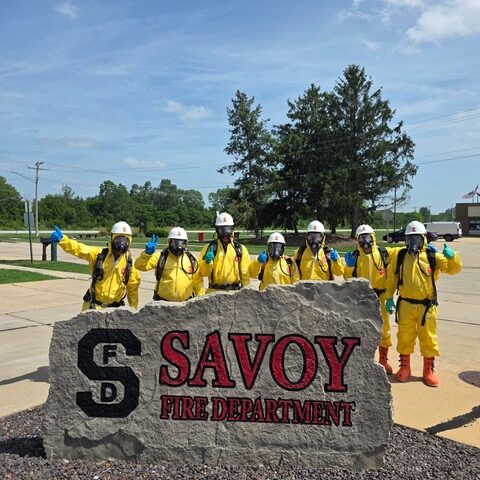
Kids These Days Don’t Want to Work (Duh)

Kids these days, I tell ya. They just don’t want to work. I hear it all the time for the older generation in my office. I can’t help but think, “Yeah, duh!”

We’re more affluent

The older generation has worked really hard. I can only assume it’s because they wanted to create a better world for their children. Thank you to those who did! The world is better now and we’d like to enjoy it. It would be a waste if you spent all that time and effort for nothing, right? 

Growing up with plenty means we don’t need “a strong work ethic.” 

https://tradingeconomics.com/united-states/gdp

We live longer

In 50 years, we’ve added about 8 years of life. That’s almost 10% more. The younger generation doesn’t need to grow up quick. We have more time to play with. More time to fall in love, or lounge around the house, or go on walks. 

“Overworked” is a bad word. We can, and need to, pace ourselves.

https://www.cdc.gov/nchs/data-visualization/mortality-trends/index.htm

What’s in it for me?

We have a perfect storm of factors that define this generation: Living in your parent’s basement smoking weed is the most popular option for people in the prime of their lives, getting married / cohabiting is now old fashioned, and living alone is the most popular it’s been since the 1880’s.

Men no longer need to be the providers for their family. And women no longer need to be dependent on men. So… what’s in it for me? Why should we put in the extra hours, be on call, and come in on weekends? 

https://www.pewresearch.org/social-trends/2016/05/24/for-first-time-in-modern-era-living-with-parents-edges-out-other-living-arrangements-for-18-to-34-year-olds/

Work sucks

I don’t have a statistic for this, but it’s a well known fact: work sucks. Ask anyone and they’ll tell you about how awful their job is. They hate their boss, or their co-workers, or this policy, etc. etc. There are a few people who say they love their job, but secretly, they hate it. Everyone would much rather be doing anything else. 

Maybe we shouldn’t lament the kids these days. Maybe they’re onto something (duh).

How to pay 0% taxes (in retirement)

I just finished a book called, “The Power of Zero,” by David McKnight. I liked what it had to say and I want to share the highlights here. 

Disclaimer: I am not a CPA, nor is David McKnight. I am not liable for anything.

There are three “buckets,” or places to stash your nest egg. 

Taxable

The first is the Taxable Bucket. If you have a brokerage account where you trade stocks, bonds, options, or mutual funds, this is taxable. First you’re taxed when you put money in, and then you’re taxed on all of the interest you’ve earned by lending your money to strangers. This is called the Capital Gains tax.

Tax-Deferred

The second is the Tax-Deferred Bucket. This is a traditional IRA. You put money in now without being taxed, but you get taxed on everything that comes out, both the principal and the earned interest (gains).

Tax-Free

The third bucket is the Roth IRA. The Roth is like the traditional IRA, except in reverse. You get taxed on the money you put in, but you can take it out tax free. The Roth is magical for two reasons. The first is that taxes are at an ALL TIME LOW. David McKnight is like a dancing inflatable arm man outside of a car dealership. In 2017 Congress passed the Tax Cut and Jobs Act of 2017 (which started Jan 1st 2018) with a clause that the policy would evaporate on Jan 1st 2026 if Congress did nothing. And as we all know, if there’s one thing Congress is good at, it’s nothing. So now we know that taxes are low, and will inevitably rise in the future. The possibility that taxes will go even lower is unfathomable. For this reason, dump money into a Roth IRA. The second reason Roth IRAs are magical is that disbursements from this fund don’t count as income.

0%

If you dumped your money into a traditional IRA instead of a Roth, you’ll be ripe for the government money harvest. There are Required Minimum Distributions at 70 ½. 

When you retire, your “income” is the first two buckets, plus half of your social security. It does NOT include your Roth. As an old person, you’ll likely only be able to take the standard deduction of $24,000. If your “income” is greater than $24,000, you’ll have to pay taxes. It’s entirely possible that your Required Minimum Distributions are too high and will put your “income” above $24,000. Oh yeah, if you make too much “income” your social security gets taxed too.

The way to game the system is to have $30,000 of distributions from your Roth, plus your $24,000 from your “income”. Now you have $54,000 of income and you are still tax free. Voila.

Bubbles and Cults

My grandmother’s meatloaf

I’ve achieved a form of Nirvana. I feel like I finally discovered what my grandmother’s meatloaf was missing. It finally clicked. 

The thing that causes stock market bubbles is the same thing that causes people to join cults.

Bubbles

To illustrate what I’m talking about, let me spell out the five stages of a stock market bubble: 

  1. Shiny new toy
  2. Keeping up with the Jones’
  3. Euphoria
  4. The emperor isn’t wearing any clothes
  5. PANIC

This pattern repeats over and over throughout history: Tulips, Spices, New World Exports, Axe Body Spray, etc.

In our desperate struggle to do better than “those other people,” we inevitably discover some very slight edge. This edge gets exploited by more and more people which creates a positive feedback loop. As more people employ this slight edge, it becomes a very big advantage. Such a big advantage, in fact, that it becomes essential. Eventually the feedback loop slows down because there isn’t enough fresh blood entering the system. Someone will come to their senses and realize that this slight edge is just a slight edge and the rest is hype. But they’re ignored because it still works, just not as well. Don’t fix what’s not on fire. Then the whole system catches on fire and people start jumping out windows.

Two opposite asymmetries

Bubbles are caused by two opposite asymmetries: the slow building of trust, and the slow spreading of bad news.

Obviously, It takes a long time to build up trust. The second factor is that no one likes to be the bearer of bad news. No one wants to be the messenger that gets shot. No one likes to be the one to tell the party go-ers that they’re being too loud and someone could call the cops.

If we were more trusting, we wouldn’t see a sharp rise. If we were more comfortable with bad news, and if we actively looked for opposing viewpoints, instead of only looking for views that reinforced our existing beliefs, we wouldn’t see a sharp fall.

Herd is the word

Herd mentality is good for when there is little data, conflicting information, high stakes, and a need for fast judgement and coordination. Humans, for all of our cunning, conniving, plotting, and planning, taste just like a gazelle. If you think a lion has escaped its cage at the zoo, don’t ask around, just start running.

Don’t drink the kool aid

It’s easy to say now, but we have the benefit of history behind us. At the time, the Peoples Temple of the Disciples of Christ sounded pretty groovy. And the Reverend Jim Jones sounded like a cool dude. In fact…

  1. People joined this group and made lots of friends around a common goal of religion.
  2. Both white and black people were joining, which meant other people felt comfortable joining.
  3. Eight hundred people move to Guyana to join a socialist paradise
  4. Congressman Leo Ryan visits and is unimpressed to say the least. The good Reverend has Ryan killed before he can leave.
  5. Mass suicide

Tying it together

Here’s how the two opposite asymmetries ties these two phenomenon together: 

In both cases, there was too much skepticism. Yes, too much. Had more people joined Rev. Jones earlier, they might have discovered his fraudulent nature sooner. And once a few defectors knew the true nature of Rev. Jones, the information spread slowly because they were shunned as non-believers. The truth was suppressed by both the leader and the followers. 

Don’t drink the kool aid… 2

So how do we prevent this from happening to us? It’s the same process but in reverse. First, we need to be intensely curious. We need to be willing to do deep dives on controversial topics. If there’s a charismatic leader on the rise, now is the best time to investigate their true motives. Second, and this builds on the first point, we need to seek out opposing views. We need the bad news to keep us grounded in reality. Any time something is too good to be true, we should be double checking.

Aaaaaand we’re back

Welcome back to another exciting episode of, “What the hell is going on (in Tucson’s life)?”

Today we have: NaNoWriMo Post Mortem, I’ve Changed My Mind (and So Should You), and What the Hell is Going to Happen Next

NaNoWriMo Post Mortem

I WON! I WON! I wrote 50,000 words in 30 days. There’s a personal competition called the National Novel Writing Month (NaNoWriMo for short). The goal is to have written a novel in a month. The point is to prove to yourself and to the world that it is possible. For all of our excuses that prevent us from ever singing the story in our heart, somehow we persevere. It’s miraculous. When I finished, I felt like I just won the Superbowl. I was flying high for two weeks. Accomplishing that feat was an incredible confidence boost. It was the hardest thing I’ve ever done. The only thing harder was doing it the first time.

The first time I did it, the story was heavily based on my favorite movie “The Matrix.” I wasted a lot of brain power wrestling with trying to be original and trying to be faithful. It was exhausting. This time it was totally, completely, unequivocally original in the sense that I copied everything but from different sources this time. My inspirations include: The Godfather, The Lion King, Prometheus Bound, BoJack Horseman, Who Shot Roger Rabbit, Mad Max, and many, many more. I felt free to pick and choose to suit my fancy. It was liberating and allowed the words to flow much freer.

I changed my narrative structure too. Instead of using Joseph Campbell’s Monomyth, aka “The Hero with a Thousand Faces,” which is 12 steps, I used Dan Harmon’s Story Circle which is 8 steps. Eighth steps is more manageable. It’s easier to contrast opposing steps (1 with 5, 2 with 6 etc.). It’s easier to define what needs to happen in order for it to flow naturally into the next step. Next year I’m going to use a 256 step story structure and see what happens.

Speaking of next year, I have to decide if I want to get this story published, or if I want to write another story. I certainly like this recent story much more than last time. It feels more gripping, cohesive, and twisty. I haven’t decided yet. In any case, I’m not going to start editing until January. I need some space and I think I need to see other people for a while. 

I’ve Changed My Mind (and So Should You)

National Debt is actually no big deal. I finished the audiobook “The Ascent of Money” by Niall Ferguson which was positively marvelous. It was so enlightening and brought so much insight that I now feel like a smart person. It changed my mind about several things, but the most striking is how normal sovereign debt is. It’s nothing new. Neither is defaulting or delaying payments. It’s not the end of the country nor the end of the world. 

I finished the audiobook “John Bogle’s Little Book of Investing” by John Bogle. It wasn’t as impressive as I hopped, but it did change my mind about how to invest in the stock market. For a long time I was obsessed about making money in the stock market like the pros. I read countless books and got countless conflicting answers. It was infuriating. I refused to be convinced that there is no right answer. Bogle’s answer is that the way to make money in the stock market is to work in the stock market; either as a stock broker, financial adviser, analyst, or just own the stock market. These people make money whether the stock market goes up or down. They live by the motto, “there’s no such thing as bad publicity.” Meanwhile, the rest of us schmucks lose money as it “churns” between parties. Everybody takes a fee for every transaction and everybody wants a piece of the pie. Even if you find a winning stock, your profits will be eaten by every middleman in america.

In an overhyped, information saturated market frenzy world, It’s a refreshingly cynical view, which is why I found it so convincing.  The conclusion is to just buy an index fund, which mirrors the performance of the top 500 companies. It’s low maintenance for you (you never have to sell) and it has low fees for the fund managers because there’s almost nothing to do. It’s low risk because even as individual companies bite the dust, the top 500 is automatically adjusted to only include the winners. Just set it and forget it.

Bogle happens to have an index fund, (stock ticker code is VTI), which is well vetted and has plenty of performance history. Yes, the whole book was one giant ad and I was duped not only into reading it, but also into buying his damn fund. I’m ok with it, though. He makes good points.

What the Hell is Going to Happen Next

Being singularly focused was grueling. I unsubscribed from almost all of the bloggers I normally read. I didn’t watch any youtube. I didn’t do any pleasure reading. It was great! I loved cutting out all distractions. I loved being done with something.

Ultimately my goal is to be a published author. Here’s 22 facts they DON”T want you to know about being a published author. You can’t just write words good. You also have to have a pre-existing audience. No publisher wants to take a risk on a backwoods nobody. An advance from a publisher is going to be anywhere from $10,000 to $50,000 and those fat checks go to people who already have an audience. If you think getting people to watch your movie is hard, try getting them to read a damn book once in a while. Publishers are looking for people with an existing “platform”: a blog, a youtube channel, 1,039 fans on facebook. An online presence. Which means next up, I need to hire an army of monkeys to write my next book while I build my platform.